

Steven Spielberg’s film Disclosure Day features a main character who is suddenly gifted with superhero-type abilities. Her unexpected—and perhaps at times unwanted—consciousness upgrade allows her to see and feel things that others cannot. It also makes her invaluable in communicating with Extra-Dimensional beings who want to share their teachings with humans.
What is the primary skill she receives in this upgrade?
An unprecedented ability to be empathetic.
Similarly, in the science-fiction film Arrival, the one woman able to advance communication with Extra-Dimensional beings displays extraordinary levels of compassion, patience, curiosity, nonviolence, nonattachment, and discipline in her process of discovering a cross-linguistic modality for communication. It is through this network of embodied and relational skills that she is able to avert world war and open the possibility for interspecies peace.
Examples of such heroines abound in contemporary science fiction. Jodie Foster’s character in Contact is distinguished by her commitment to deep listening and understanding. Maeve in Westworld is primarily motivated by her drive to protect future generations. Dolores, in the same series, after being reborn multiple times, ultimately chooses—despite the horrific violence she has experienced—to orient herself toward beauty and love.

What fascinates me about these characters is not simply that they are compassionate women. It is that the stories repeatedly imagine capacities culturally coded as soft, feminine, spiritual, or premodern as technologies necessary for humanity’s next evolutionary threshold.
Empathy, in these stories, is not sentimentality. It is the antidote to a world of misunderstanding and chaos. It is intelligence and perceptual technology.
As a somatic practitioner, culture strategist, and Indigenous artist, I am impressed by the ways contemporary woman-centric science fiction mirrors:
Themes central to many Turtle Island Indigenous teachings.
Core strategies of contemporary somatic psychology.
Key principles within Eastern philosophical traditions.
Mind states and practices involving unconditional love, nonviolence, nonattachment, deep empathy, interconnectedness, and attention to how actions ripple through time appear across many Indigenous teachings, somatic methodologies, and Taoist and Buddhist philosophies.
Although these traditions are neither interchangeable nor reducible to one another, they cultivate a number of related capacities: the ability to perceive relationship, remain present with complexity, regulate reactivity, observe consequence, and respond without immediately attempting to dominate what is different. Together, these capacities begin to resemble something like an Empathy Operating System.
Empathy here does not simply mean “I feel what you feel.” It is the capacity to perceive the interiority and needs of another being without collapsing the distinction between self and other. It requires enough nervous-system regulation to remain curious when confronted with difference; enough nonattachment to receive information that challenges one’s existing story; enough imagination to conceive of realities outside one’s own; and enough love to remain in relationship without needing to possess, control, assimilate, or destroy.
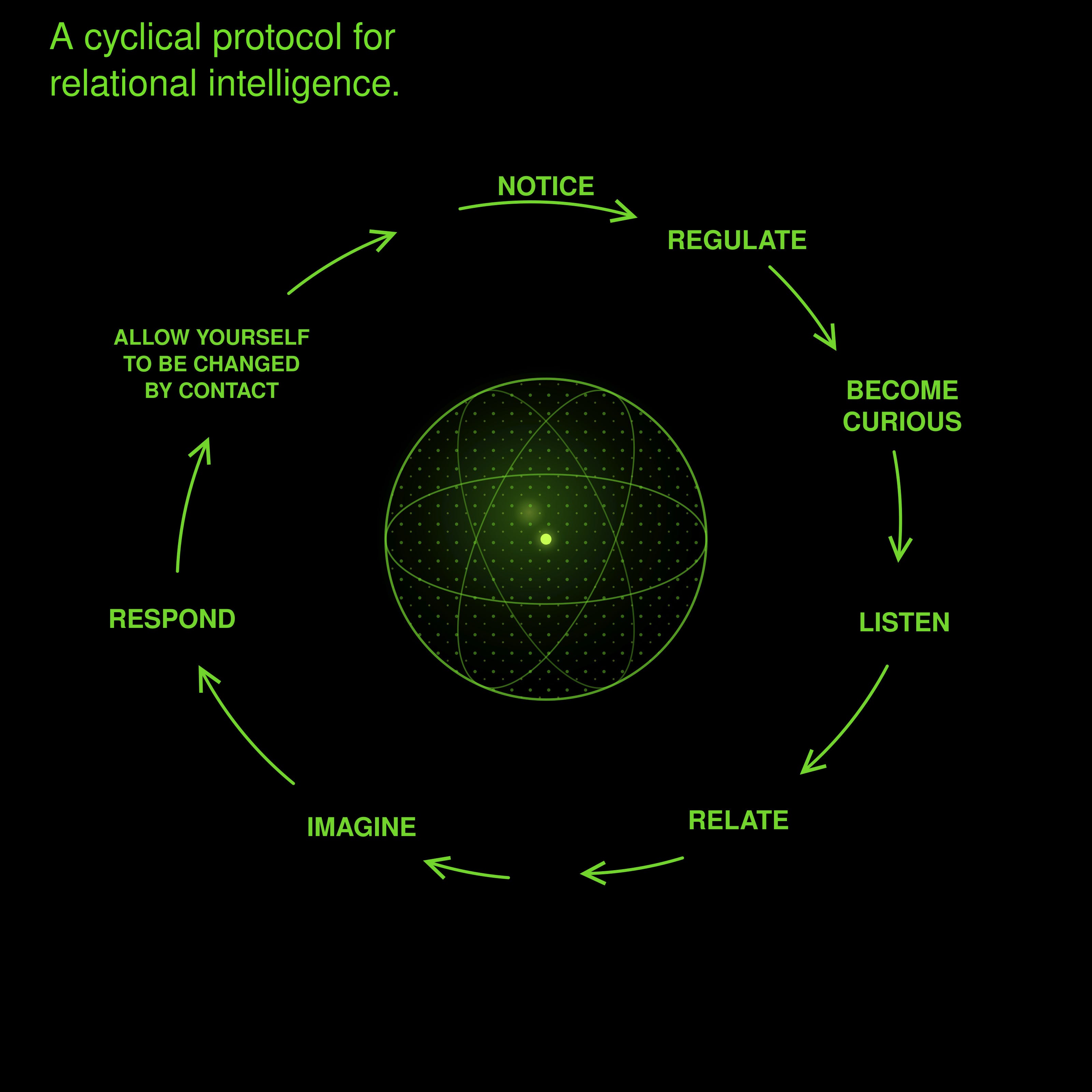
In this sense, empathy is not a single capacity, but a cyclical relational protocol:
Notice →Regulate → Become Curious → Listen → Relate
—————→ → → →
Imagine → Respond → Allow Change Through Contact
The quality of our presence affects what we can perceive. What we perceive shapes our interpretation. Interpretation determines what possibilities become imaginable. And what we imagine possible determines how we respond.
Change the operating system, and the exact same information produces an entirely different set of outcomes.
EXISTING OPERATING SYSTEMS
US capitalist and technocentric cultures are linked through a colonial quest for “more, better, faster, now” (reminiscent of the Daft Punk song Harder, Better, Faster, Stronger). In his book In the Absence of the Sacred, Jerry Mander categorizes this behavioral cluster into eleven unspoken rules. He classifies them as applying specifically to corporate behavior. But I argue that corporate behavior plays such a dominant role in informing US culture that it is the driving cultural institution.
Corporations, regardless of our opinions or preferences for them, play an indisputable role in shaping media, legislation, governments, and the physical infrastructure of the built environment. The United States is beholden to capitalism (and the corporate entity enforcing it) more than almost any other value structure.
Corporate interest supersedes government or democratic values, human interests, cultural interests, and religious interests. It is the driving behavioral and value structure in dominant US culture. As such, its influence on the collective consciousness—whether preferred or not—is ubiquitous. To such a degree, many people internalize the values, assumptions, and logic of corporations without a second thought.
Mander outlines these 11 corporate behaviors:
The profit imperative
The growth imperative
Competition and aggression
Amorality
Hierarchy
Quantification, linearity, and segmentation
Dehumanization
Exploitation
Ephemerality
Opposition to nature
Homogenization
What does it mean to exist within a culture run by these behaviors? If the so-called 1% is running this operating system, how does it influence the 99% in our thought infrastructure? In somatics and psychology, we know that many experiences are encoded into the brain and body between 1 and 2 years old. At this point, a human is pre-linguistic, and explicit memory encoding has not yet come online. Yet, the events experienced during this time are still tracked by the body and have a profound impact not just on an individual’s behaviors later in life, but also on their assumed beliefs about the nature of reality itself.
Corporations and their influence on the collective imaginary have a similar impact. Advertising, social agreements, and assumptions about how to interact with one another and the world around us function mostly through the retrieval of implicit memory—memory that is often not formed into words and functions below conscious awareness. Research in neuroscience demonstrates that the body often initiates decisions before the conscious mind realizes what it will do or why. Studies into this phenomenon suspect that what we commonly call the brain or conscious mind is making up stories to justify what the body has already decided to do.
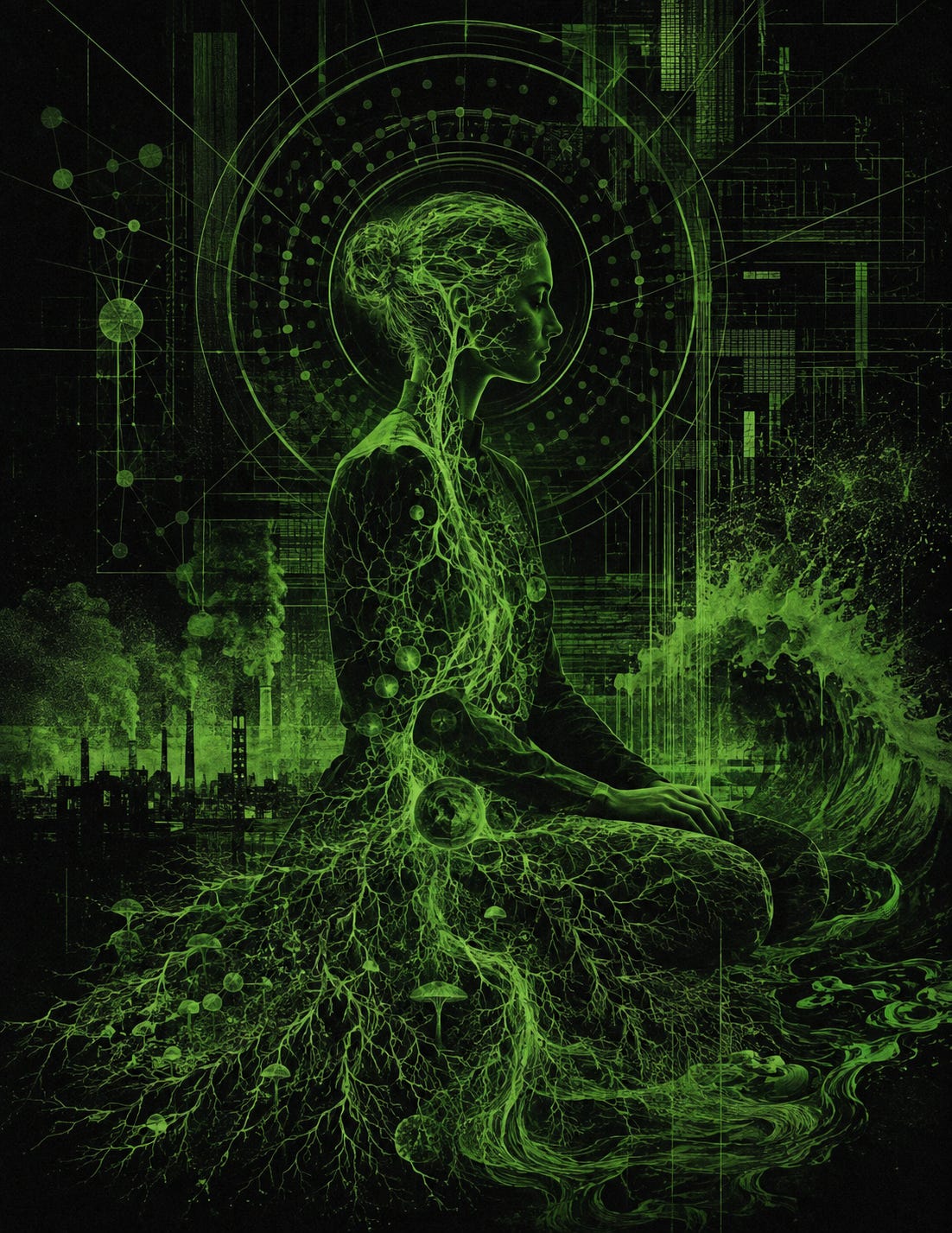
Yet, this raises a crucial question: If we are born into systems of scarcity, hierarchy, and competition, where does our original medicine—the original system—live? Is the Empathy Operating System strictly an “upgrade,” or is it an act of remembering something we already knew before these extractive systems were layered onto us?
The answer lies in our physiology and ancestral lineage. The body’s baseline architecture for co-regulation, interoception, and relational connection is millions of years older than industrial capitalism. Scarcity and hierarchy are recent historical overlays; our core nervous system was built for belonging, safety in community, and ecological interdependence. Therefore, this “upgrade” is not installing foreign software, but activating latent biological and ancestral memory that dominant systems have suppressed.
When corporations work behind the scenes using advertising that moves faster than our evolutionary nervous system, or creating technology out of sync with natural rhythms, they work at the implicit somatic level to alter our consciousness. Is this action malicious? The question is largely misleading. From a Buddhist, somatic, and Indigenous perspective, it simply is the nature of its being. The critical part is what we do with our consciousness and actions as a result of recognizing this.
The implicit ripples of corporate behavior on the collective consciousness produce 11 distinct limitations of the imaginary:
Anxiety around resources: A constant desire for more and a perpetual feeling of lack—not enough time, money, love, or intimacy.
Anxiety around self-worth: Constant fear of not being skinny, smart, or strong enough; a compulsion to fix oneself and others.
Unending state of comparison: Fluctuation between superiority and inferiority, preoccupation with social hierarchy, a desperate need to be right, and intense anxiety around being wrong.
Fear of exposure and vulnerability: Anxiety about having one’s projections directed back at oneself, imposter syndrome, and a resultant dread of authentic vulnerability.
Erosion of integrity: Only taking careful action when paid, observed by authority, or facing immediate explicit consequences; failing to recognize the interconnectedness of thought and action.
Lack of agency: A persistent state of self-victimization, learned helplessness, and reliance on narratives of “should, need to, have to” rather than autonomy and curiosity.
Skepticism toward holistic worldviews: Inability to tolerate complexity, boredom, wonder, or ineffability; an urgent need to categorize, label, and dismiss.
Dehumanization and human imperialism: Desensitization to others’ pain, using diagnostic or typological labels to pathologize needs, treating the more-than-human world without honor, and believing land or water can be owned.
Institutionalized selfishness: Embracing selfishness as a primary engine of civilization, leaving us isolated and in perpetual conflict.
Fractured responsibility: Emulating corporate ephemerality by deflecting accountability onto parents, governments, or neighbors rather than exercising agential internal autonomy.
Opposition to nature: Living in deep, invisibilized antagonism to natural cycles, relying on technology that hijacks attention and produces constant baseline anxiety.
The sum result of these cultural qualities is an unending push toward consumption and a continual displacement of meaning into the external and the future: a pathological aversion to the here and now.
Popular media like Disclosure Day, Arrival, Contact, and Westworld, alongside feminist speculative literature such as The Kin of Ata Are Waiting for You and Parable of the Sower, prefigure another kind of skill-building futurism: one in which the successful evolution of the species depends not upon greater domination of the external world, but greater sophistication of consciousness.
For those drawn to evolutionary thresholds, these visionaries point toward a simple conclusion: The only way out is in—out of capitalism, out of suffering, out of oppression, and inward toward understanding, cultivation of love, and a deepening commitment to right action and right livelihood.

THE ANXIETY OF INBETWEENNESS
Contemporary US culture is awash with New Age neoshamanism, accusations of appropriation, Indigenous cultural reclamation, and widespread confusion about what it means to live with cultural authenticity and integrity.
A related tension surrounds gender, sexuality, and identity. Many Indigenous worldviews and contemporary queer ecologies look toward nature for understandings of balance, plurality, and inbetweenness. Dominant technocentric society, by contrast, remains deeply shaped by Cartesian separation and binary classification: mind/body, human/nature, civilized/primitive, masculine/feminine, subject/object. A binary operating system experiences nonbinary information as error or chaos.
This is why the explicit recognition and re-emergence of nature’s innate nonbinariness—whether in sexuality, ecology, consciousness, or economics—generates such disproportionate cultural anxiety. It reveals weaknesses in the logic infrastructure of the dominant imaginary itself.
Inbetweenness anxiety is stressful not only for an individual whose life has been mapped through binary classification, but for the economic and cultural systems scaffolded upon those classifications. Plurality is treated as the proverbial tugging of a thread that might undo the whole sweater.
But perhaps the sweater has already unravelled. Perhaps it is only the skeleton of itself lying in the sand, waiting for a strong gust of wind to reveal its actual condition.
That wind may be labeled immigrants, queer people, trans people, women, witches, or any number of marginalized communities. But the people blamed for the unraveling are not the cause of the undoing. Instead, they point toward what already is. The undoing is already done.
And what happens after that collective realization? Grief and rebuilding.
Grief is the necessary threshold through which we honor what was lost: the severed relationships, the extracted lands, the suppressed ancestral languages, and the generations spent enduring the cold logic of an extractive machinery. To rebuild without recreating the same coercive operating system, we cannot simply swap who holds the whip. Rebuilding requires anchoring ourselves in somatic self-regulation, decentralized agency, and a profound reverence for nature’s inherent laws.
Indigenous cultures, including the Hopi and Haudenosaunee, note that they do not follow arbitrary human laws, but rather “nature’s laws.” They observe reality as it actually is, developing cultural agreements that support the well-being not just of the tribe, but of the whole living system.
MATRICIRCULARITY AS RESPONSIBILITY
There are many misunderstandings surrounding the meanings of matrilineal and matriarchal cultures. The words themselves seem to imply a binary opposition to patriarchy: if patriarchy means men dominating women, matriarchy must mean women dominating men.
Within cultures such as the Haudenosaunee, Hopi, and Diné, systems described as matrilineal developed within a larger relational worldview oriented toward balance, continuity, and responsibility.
To move beyond the limitations of English linguistic binaries, I propose a new term: Matricircularity (or Matricircular living).
Matricircularity highlights that these worldviews center circularity, relationship, distributed power, responsibility, and collective well-being rather than linear hierarchy or domination.
In Haudenosaunee, Hopi, and Diné traditions, women hold central responsibilities for stewardship of the land and household authority. In the Haudenosaunee confederacy, a council of elder women appoints—and can de-role—male community leaders. The leader is not a dictator or president, but a facilitator and word-carrier who gathers people peacefully. Furthermore, women historically held decision-making authority regarding whether to enter conflict, knowing most intimately the generational cost of war.
Matricircularity is a way of living that centers abundance, sufficiency, and decentralized agency. Like a loving parent who nurtures each child’s unique gifts so the whole household thrives in peace, matricircularity views the collective through a lens of pluralistic harmony.
Consider the story of Jigonsaseh (Gigonsesa), the Indigenous woman who helped unite the original nations of the Haudenosaunee Confederacy alongside the Peacemaker. When confronting a leader notorious for horrific war crimes, Jigonsaseh did not advocate for punitive banishment or execution. Instead, she offered him a path of alchemy and transformation, proposing that he become a key council leader if he embraced the Great Law of Peace.
This distinction stands in sharp contrast to modern punitive justice systems, which offer little opportunity for genuine restoration or integration. Matricircularity provides a threshold for choice, healing, and re-integration.
Matricircularity asks:
What are my responsibilities to children? To ancestors? To future generations?
What are my responsibilities to land, water, animals, and the stranger?
What are my responsibilities to the person with whom I profoundly disagree?
The answers cannot be determined solely by legal entitlement. They require perceiving relationship itself—and this is where empathy becomes infrastructure.

ILLUSIONS OF OWNERSHIP
One of the most dangerous illusions embedded in dominant consciousness is the concept of ownership—the belief that one entity can possess and control land, people, animals, or knowledge.
When newcomers arrived on Turtle Island operating from internalized trauma and historical scarcity, they encountered Indigenous peoples whose cosmologies explicitly prohibited land ownership. Jerry Mander notes that newcomers had three primary struggles with traditional Indigenous governance:
Communal stewardship of land and spiritual strictures against selling it.
Consensual decision-making.
Absence of a central hierarchical authority empowered to make binding deals.
The newcomers’ operating system relied on competition, hierarchy, quantification, dehumanization, and force. Driven by an unintegrated “pain-body” (in Eckhart Tolle’s terminology), they projected labels of “savagery” onto Indigenous peoples despite relying on their assistance for survival.
This extractive logic cascade continues today in bureaucratic battles over land rights in Alaska, Nevada, and Standing Rock. In In the Absence of the Sacred, William Tyson, a Yupik elder, summarized the quagmire of imposed property lines:
“I don’t know of any other way of making a living besides living off the land and working together with my neighbors. If we see somebody to help, we go down and help him.... There used to be some woman coming up and picking berries right outside of our house. My wife would open that door and say ‘Hey, the coffee is good, won’t you come in and have some coffee with me?’ The woman who picked berries right outside of my house would come into my home and have coffee with my wife in the house. That was before we got cautious. Then, after we were told that we had to have a boundary around our property, then anybody comes and tells us, that one is trespassing and I can do as I please with him. Okay. I’m not helping him no more, just driving him away. That is not preserving the land the way it should be.”
When relationship becomes resource, the resulting worldview requires that some lives become expendable, some ways of knowing become illegitimate, and hierarchy becomes a necessary technology for extraction.

TIME, NARRATIVE, AND THE SENSITIVITY CYCLE
Western liberal political culture is obsessed with rights—the right to speech, property, and individual entitlement. Far less attention is given to responsibility.
Responsibility here does not mean burden or punishment. It means response-ability: the cultivated ability to perceive consequence and choose right action. When Onondaga Faithkeeper Oren Lyons was asked about the relationship between the Haudenosaunee Confederacy and the United States, he remarked: “We have been working on our democracy for a very long time. You guys have a few years under your belt. How’s that going?”
His perspective fundamentally shifts the temporal scale of contemporary crisis culture. Industrial modernity relies on speed and urgency, making us faster and reactive.
Somatic psychology provides tools to map how we react under these conditions. Ron Kurtz’s Hakomi method outlines four stages in the Sensitivity Cycle (or Action Cycle):
Clarity: Recognizing our genuine feelings, needs, and desires.
Effectiveness: Taking skillful action to meet those needs.
Satisfaction: Experiencing resolution and receiving nourishment when needs are met.
Relaxation: The somatic and emotional capacity to rest, integrate, and return to baseline presence.
Dominant culture breeds blockages at every stage—particularly in Relaxation (manifesting as chronic anxiety and perpetual productivity) and Effectiveness (manifesting as depression and learned helplessness).
To heal these blockages, we require two core practices: Mindfulness (staying present in the current moment) and Intimacy (trust and safety in relational connection).
EMPATHY, DIFFERENTIATION, AND OCTOPI
In Arrival, it is Louise’s capacity to remain present and connected with the heptapods that allows her to learn their non-linear language. In Contact, Ellie Arroway prioritizes authentic presence and relational respect over her demands for intellectual control.
This brings us to the octopus. An octopus possesses a nervous system distributed throughout its limbs, with neural architecture operating largely outside a central brain. It presents a profound challenge to human definitions of intelligence.
If intelligence evolved in such a radically distinct form on our own planet, are we perceptually sophisticated enough to recognize intelligence that does not resemble our own?
The colonial operating system approaches difference through a rigid sequence:
categorize → rank → possess → control / dominate/ suppress → assimilate / exclude
The Empathy Operating System offers a transformative / ancestral alternative:
notice → regulate → become curious → listen → relate → imagine → respond → allow oneself to be changed by contact
This final step requires surrender—an openness to being transformed by contact with the Other.

APPLYING IT OUT: ANCESTRAL FUTURES
The Empathy Operating System is not a theoretical philosophy; it is an ongoing practice across four distinct scales:
At the Individual Scale: Developing somatic literacy to notice nervous system dysregulation before defense becomes worldview.
At the Interpersonal Scale: Maintaining differentiation without becoming disconnected.
I do not need to become you to understand you.
I do not need to agree with you to recognize your humanity.
I do not need to surrender my boundaries to remain in relationship.
In nature, this balance between unity and differentiation is foundational. Consider embryonic development: a sperm and egg unite into a single cell (zygote), which immediately begins dividing and differentiating into specialized, distinct tissues—not to break unity, but to form a complex, integrated living whole. In the same way, true empathy does not demand enmeshment or homogenization; it requires distinct individuals remaining relationally connected within the larger whole.
At the Community Scale: Treating conflict not as failure, but as information that increases the intelligence of the system through restorative practices.
At the Species Scale: Recognizing that humanity’s next evolutionary threshold is not biological or computational, but relational.
Contemporary science fiction keeps returning to the sensitive empath. We imagine traveling light-years across space to make first contact, yet every encounter with another human, animal, or ecosystem is already a contact zone.
The technologies required for our
survival are not waiting to be invented in a laboratory. They are ancient ancestral capacities: presence, deep listening, ceremony, responsibility, nonviolence, embodied perception, and relationship.
Is our next evolution a leap forward, a remembering backward, or both at once?
Perhaps what looks like futurism from inside the dominant culture is simply memory returning from somewhere else. The future is ancestral. When humanity finally reaches its next evolutionary threshold, we will not survive by sending our strongest warrior or wealthiest billionaire.
We will send the person who knows how to listen.
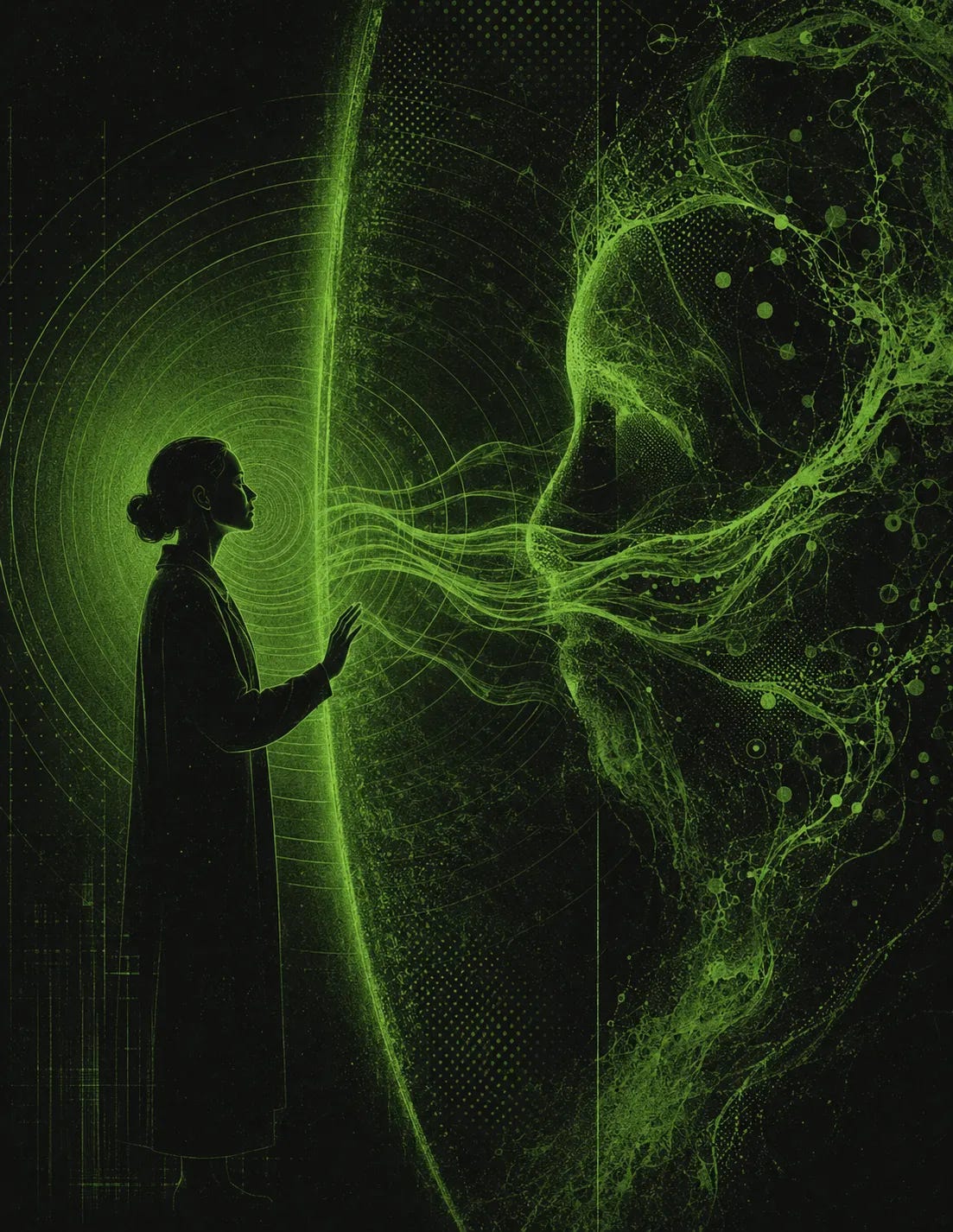
This essay was conceived, researched, and written by the author. AI-assisted editorial tools were used selectively for feedback, refinement, and visual development; the ideas, analysis, lived experience, and final editorial decisions are my own.